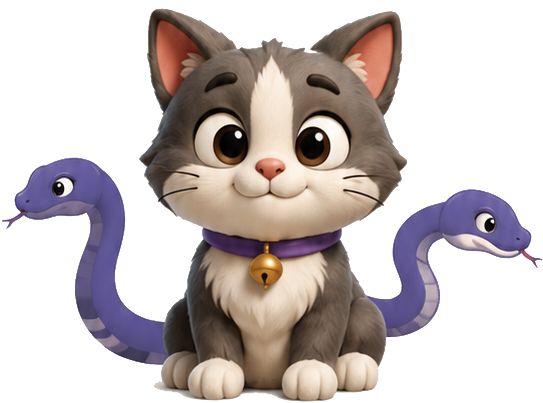

Begin with a shape and a cat pocket
A board starts with a regular footprint or an approved silhouette. The cat gets its own protected pocket. Every remaining playable cell must belong to exactly one snake, so the final design fills the shape without accidental gaps or overlapping bodies.
Make the routes feel different
The puzzle system favors irregular winding paths: a memorable long route when space allows, varied medium routes, and a few shorter pieces. Mixed directions and uneven turns avoid the look of repeated rows or identical U-shaped tiles.
Check the blockers
The game traces the straight ray in front of every head and records which snakes block it. Those relationships form a dependency graph. A solver verifies that removing available snakes can eventually clear the whole board. A legal exit only removes blockers; it never adds one.
Measure work, then shape the journey
Snake count is only part of difficulty. The number of opening moves, depth of blocker chains, and choices during the solve matter too. The campaign arranges harder puzzles and relief in waves. Fixed board identities keep the accepted geometry and saved progress stable as new levels are added.
Common questions
Are boards invented again every time I open them?
No. Accepted campaign boards use deterministic geometry and stable identities.
Can two snakes overlap?
No. The level rules reject overlap and self-crossing.
Does a special shape automatically mean a hard puzzle?
No. Difficulty follows the measured work of the solution, not the appearance alone.